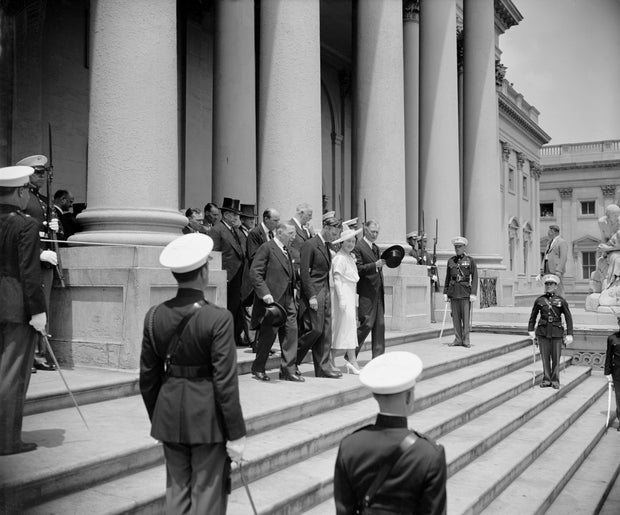
Photographs of British royals on American soil do more than document state visits—they capture moments where diplomacy, culture, and personality intersect. As King Charles III embarks on a state visit to the United States, historical images of his predecessors across the 20th and 21st centuries reveal a quiet evolution in Anglo-American relations. From wartime solidarity to modern ceremonial diplomacy, these visuals tell a story not just of protocol, but of personal connection and political symbolism.
The First Steps: Edward VIII and the Pre-War Diplomacy Before World War II reshaped global alliances, royal visits were rare and often personal rather than official. The first British royal to visit what would become U.S. soil in a semi-diplomatic capacity was Edward, Prince of Wales—later Edward VIII—during a 1924 tour.
Photographs from that trip show a young, dashing prince in a Panama hat strolling through Manhattan, shaking hands with steelworkers in Pittsburgh, and touring Niagara Falls. The images were widely circulated in American newspapers, helping humanize the monarchy during a period of growing transatlantic media exchange.
This wasn’t a state visit in the modern sense—there was no White House dinner or congressional address—but it laid groundwork. The tour was framed as a gesture of goodwill between two English-speaking powers. At a time when isolationism still gripped American foreign policy, the photos served as soft propaganda: a reminder of shared heritage.
Key takeaway: Edward’s 1924 tour was less about policy and more about presence—proving that even a future abdicator could be a diplomatic asset through visibility alone.
World War II and the King Who Stayed: George VI's Symbolic Presence
No royal visit had greater historical weight than King George VI and Queen Elizabeth’s 1939 journey to North America. Though technically a tour of Canada, their stop in the U.S.—including a now-iconic picnic at Franklin D. Roosevelt’s home in Hyde Park—was a pivotal moment in Anglo-American alliance-building.
Photographs from the Hyde Park outing show an informal scene: the King and FDR laughing over hot dogs, the Queen seated on a lawn chair in a floral dress, children playing nearby. The image of the British monarch eating a hot dog—bun and all—was carefully staged but powerful. It communicated humility, approachability, and solidarity.
This was no mere photo op. With war looming in Europe, the visit helped sway American public opinion toward supporting Britain. The photos were used extensively in U.S. media to soften perceptions of the British elite, framing the monarchy as relatable allies rather than distant aristocrats.
Why it mattered: The 1939 visit helped shift American sentiment from neutrality to sympathy—a crucial step toward Lend-Lease aid and eventual entry into WWII.
The Elizabeth Era: Diplomacy in High Definition
Queen Elizabeth II’s six-decade reign included more U.S. visits than any other monarch—eight official trips, several informal stops, and one historic state visit for the Bicentennial in 1976.
Photographs from her 1957 trip—her first as queen—capture Cold War context: she addresses a joint session of Congress, stands beside President Eisenhower at Camp David, and attends a glittering White House dinner. The images radiate formality, yet subtle details stand out: her crisp hats, the way she holds her gloves, the precise tilt of her head when listening.
:max_bytes(150000):strip_icc():focal(728x275:730x277)/princess-catherine-prince-william-donald-trump-king-charles-iii-trump-state-visit-uk-windsor-091725-8672599a27214b6f8ffdbb07fd7596e4.jpg)
By contrast, her 1991 Gulf War-era visit shows a different tone. Standing with President George H.W. Bush, she tours a military base in Virginia, shaking hands with troops. The photo carries dual messages: loyalty to an ally, and royal support for service members.
None was more symbolic than her 2007 visit, marking the 400th anniversary of Jamestown. In one photograph, she stands beside Virginia Governor Tim Kaine, both smiling at a recreated colonial settlement. The moment was rich with irony: the monarch whose ancestors once ruled American colonies, now visiting as a guest of a democratic republic.
Pattern in the photos: As decades passed, royal imagery shifted from stiff ceremony to curated warmth—reflecting both media evolution and strategic soft power.
Prince Charles Before the Crown: The Heir’s American Footprint
Long before becoming king, Charles made dozens of trips to the U.S.—some ceremonial, others focused on his charitable work. Photos from these visits show a man refining his public role.
In 1993, he toured New York following the first World Trade Center bombing, laying a wreath at the site. The image—Charles in a dark overcoat, head bowed—resonated deeply. It foreshadowed his later emphasis on empathy and resilience.
Later visits focused on environmental causes. A 2012 photo from a speech in San Francisco shows him gesturing passionately about climate change, flanked by solar panels. Unlike his mother’s state visits, Charles’s trips often blended advocacy with diplomacy, using media moments to amplify causes.
These U.S. appearances helped shape his public image beyond the tabloid narratives. The photos weren’t just about presence—they were part of a decades-long effort to redefine the monarchy’s relevance.
Common mistake in media coverage: Treating these visits as mere tourism. In reality, each stop was calibrated—balancing public engagement, policy messaging, and royal branding.
Charles III’s State Visit: Legacy in Motion
Now, as King Charles III undertakes his first state visit to the U.S., the photographic narrative enters a new chapter. The images from this trip will be scrutinized not just for their content, but for their subtext: How does a modern, climate-conscious, post-imperial monarch engage with the world’s dominant superpower?
Expect moments designed for maximum symbolism—the joint appearance with the President, a toast at the White House, perhaps a visit to a green energy project. But the real story will be in the quieter shots: a handshake with a young activist, a glance during a solemn memorial, a laugh shared with the First Lady.
Unlike past visits, this one unfolds in a hyper-visible media landscape. Photos will circulate instantly across platforms, dissected for tone, attire, and body language. A single image—like Charles pausing at a veterans’ memorial or touring a community garden—could define public perception more than any speech.
What to watch for: - How the King balances tradition with modernity in ceremonial settings - Whether environmental advocacy is visually integrated into official events - The role of Queen Camilla as a diplomatic partner in softer, community-focused moments
The Power of the Frame: Why Royal Photos Resonate
Photographs of royal visits do more than document—they shape memory. A single image can encapsulate an era’s politics, aesthetics, and aspirations.
- Consider three photos side by side:
- Edward VIII in 1924, smiling beside a Ford factory worker
- George VI eating a hot dog in 1939
- Elizabeth II in 1976, wearing a red, white, and blue gown at a Bicentennial ball

Each tells a story of adaptation. Each uses visual cues to bridge cultural divides. And each was carefully managed—by royal staff, presidential aides, and press photographers working in tandem.
Limitations of the medium: Photos freeze moments, but rarely show context. The 1939 picnic image radiates camaraderie, but doesn’t reveal FDR’s political calculations or the King’s anxiety about the coming war. Modern audiences must read between the pixels.
Behind the Lens: How Royal Visits Are Photographed
Official royal visits generate hundreds of images, but only a few become iconic. The process is tightly choreographed.
White House photographers work with royal staff to plan key moments: arrival shots, toasts, gift exchanges. Angles are chosen for maximum symbolic impact—low shots to convey dignity, wide frames to show inclusivity.
Security considerations limit spontaneity. Unlike candid paparazzi shots, state visit photography is controlled, often using telephoto lenses from fixed positions. Yet even within these constraints, authentic moments emerge: a shared laugh, a hand on a shoulder, a child waving from a balcony.
Workflow tip for journalists: Focus not just on the main event, but on peripheral figures—the local schoolchildren in the crowd, the Secret Service agent adjusting an earpiece, the aide holding an umbrella. These “background” images often reveal more about the visit’s mood.
A Dynasty in Pictures: What the Archive Reveals
The cumulative effect of decades of royal visit photography is a visual archive of Anglo-American diplomacy. It shows a monarchy adapting—sometimes awkwardly, often skillfully—to changing global dynamics.
From empire to alliance, from formality to relatability, the photos trace a path of mutual respect between two nations that, despite their shared language, often diverge in values and governance.
King Charles III’s visit continues this legacy. Whether planting a tree with the President or speaking to young entrepreneurs, each photo will add to a narrative that began nearly a century ago.
And when future historians look back, they won’t just read speeches or review policy statements. They’ll study the images—because sometimes, a single frame tells the whole story.
Closing insight: The most powerful royal photos aren’t the grandest—they’re the ones where humanity breaks through protocol. It’s in those moments that diplomacy feels real.
FAQ What was the first official British royal visit to the U.S.? King George VI and Queen Elizabeth’s 1939 trip included a historic stop at FDR’s Hyde Park, widely considered the first high-level royal engagement on U.S. soil.
Has King Charles III visited the U.S. before as monarch? Yes—his first state visit as king includes meetings with the President, a White House dinner, and public engagements focused on climate and heritage.
How are royal visit photos selected for public release? Official photographers from both nations coordinate with royal and presidential staff to release curated images that highlight key diplomatic and ceremonial moments.
Did Queen Elizabeth II visit the U.S. during the Cold War? Yes—she visited in 1957, 1976, 1981, and 1991, often using the trips to reinforce the U.S.-UK alliance during tense geopolitical periods.
Are royal state visits tax-funded in the U.S.? No—U.S. public funds cover security and logistics, but the royal family’s travel and accommodations are typically paid by the UK’s Sovereign Grant or private sources.
Why are state visits photographed so formally? Formal staging ensures security, respects protocol, and allows for controlled messaging—though candid moments are often captured by press pool photographers.
Do royal visit photos influence public opinion? Yes—images of warmth, humility, or solidarity (like George VI eating a hot dog) have historically helped shape favorable perceptions of the monarchy in the U.S.
FAQ
What should you look for in Royal Encounters: British Monarchs in America Over the Decades? Focus on relevance, practical value, and how well the solution matches real user intent.
Is Royal Encounters: British Monarchs in America Over the Decades suitable for beginners? That depends on the workflow, but a clear step-by-step approach usually makes it easier to start.
How do you compare options around Royal Encounters: British Monarchs in America Over the Decades? Compare features, trust signals, limitations, pricing, and ease of implementation.
What mistakes should you avoid? Avoid generic choices, weak validation, and decisions based only on marketing claims.
What is the next best step? Shortlist the most relevant options, validate them quickly, and refine from real-world results.